-

December 8, 2018
The Feast of the Immaculate Conception celebrates the solemn belief in the Immaculate Conception of the Blessed Virgin Mary. It is universally celebrated on December 8, nine months before the feast of the Nativity of Mary, which is celebrated on September 8.
Read More
-

December 1, 2018
Advent comes from the Latin word meaning "coming." Jesus is coming, and Advent is intended to be a season of preparation for His arrival. While we typically regard Advent as a joyous season, it is also intended to be a period of preparation, much like Lent. Prayer, penance and fasting are appropriate during this season.
Read More
-

September 1, 2018
The traditional date of the feast, September 8, falls exactly nine months after the feast of the Immaculate Conception of Mary. Perhaps because of its close proximity to the feast of the Assumption of Mary, the Nativity of the Blessed Virgin Mary is not celebrated today with the same solemnity as the Immaculate Conception. It is, nonetheless, a very important feast, because it prepares the way for the birth of Christ.
Read More
-

July 8, 2018
The feast of the Precious Blood of our Lord was instituted in 1849 by Pius IX, but the devotion is as old as Christianity. The early Fathers say that the Church was born from the pierced side of Christ, and that the sacraments were brought forth through His Blood.
Read More
-

May 8, 2018
www.therosary3.com is a beautiful place where you can close your mind to everything around, and simply contemplate Jesus and Mary. The website is easy to navigate. It is ideal for individual meditation, family or group prayer. This is God's work, created with love and it purely seeks to enrich people's faith through what has always been a beautiful prayer
Read More
-

April 8, 2018
Easter is the greatest feast in the Christian calendar. On this Sunday, Christians celebrate the resurrection of Jesus Christ from the dead. For Catholics, Easter Sunday comes at the end of 40 days of prayer, fasting, and almsgiving known as Lent. Through spiritual struggle and self-denial, we have prepared ourselves to die spiritually with Christ on Good Friday, the day of His Crucifixion, so that we can rise again with Him in new life on Easter.
Read More
-

April 1, 2018
The first name comes from the fact that it commemorates Jesus' triumphal entry into Jerusalem, when the crowd had palm branches (John 12:13). The second name comes from the fact that the narrative of the Passion is read on this Sunday.
Read More
-
November 8, 2017
The month of November is dedicated to the Souls in Purgatory, whose feast is celebrated on November 2. With the exception of the last Sunday, November falls during the liturgical season known as Ordinary Time and is represented by the liturgical color green. The last Sunday, which marks the beginning of the Advent season, the liturgical color changes to purple, representing a time of penance.
Read More
-
November 8, 2017
The month of November is set aside to celebrate the accomplishments and faithfulness of Black Catholics from the very beginnings of the Church. For more information on National Black Catholic History Month visit: http://adw.org/black-catholic-history-month/
Read More
-
October 31, 2017
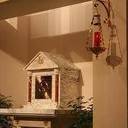
In every Catholic Church, there is a 'box' called the tabernacle where consecrated Hosts (Our Lord Himself) are reserved for adoration, worship, and for distribution of Holy Communion during the Mass and for the sick. One way to recognize the tabernacle is that usually a red or white candle will be burning very close to it to tell us that our Lord is present in the tabernacle. If the Blessed Sacrament is for some reason removed from the tabernacle, the light will be put out.
Read More
-

August 8, 2017
In 1950, in the Apostolic Constitution Munificentissimus Deus, Pope Pius XII proclaimed the Assumption of Mary a dogma of the Catholic Church in these words: "The Immaculate Mother of God, the ever-virgin Mary, having completed the course of her earthly life, was assumed body and soul into heaven." That belief was ancient, dating back to the apostles themselves. What was clear from the beginning was that there were no relics of Mary to be venerated, and that an empty tomb stood on the edge of Jerusalem near the site of her death. That location also soon became a place of pilgrimage. (Today, the Benedictine Abbey of the Dormition of Mary stands on the spot.)
Read More
-
June 8, 2017
The Church celebrates the Solemnity of the Sacred Heart of Jesus on the Friday following the second Sunday after Pentecost. In addition to the liturgical celebration, many devotional exercises are connected with the Sacred Heart of Jesus. Of all devotions, devotion to the Sacred Heart was, and remains, one of the most widespread and popular in the Church.
Read More
-

April 8, 2017
The Vatican City/papal flag consists of two equal vertical stripes of yellow and white (with the insignia of the papacy on the white stripe), a triple tiara over two crossed keys, one of gold and one of silver, tied with a red cord and two tassels. The divisions of the tiara represent the teaching, sanctifying and governing offices of the pope. The keys symbolize his role as the successor of St. Peter and the universal spiritual authority of the Holy Father. The papal flag is also a national flag as it represents the sovereign state of Vatican City.
Read More
-

April 8, 2017
The crucifix is meant to be real and part of the artist’s experience. The crucifix had to show real suffering. Actually, the crucifixion of Jesus is also redemption through suffering and death. I wanted to show it. This crucifix also portrays Christ as primarily a black man, which I believe is important to show. Being Black in the world and especially in this country, our suffering is united with Christ’s suffering – but glorious suffering.
Read More
-

February 8, 2017
Many Catholic altars, have three steps leading from the floor to the level of the altar. This is used to symbolize the trinity of Father, Son and Holy Spirit. In walking up the steps at the beginning of Mass, the Priest, who acts in the place of Christ at each Mass, also symbolically acts out Christ’s literal rising from the earthly tomb after three days, completing the sacrifice and redemption that is re-presented at every Catholic Mass throughout the world.
Read More
-
April 8, 2011
Did you ever wonder how the Bible came into being? A little known, but easily documented fact is that the books of the Bible were compiled by the Catholic Church. For many years after Christ ascended into Heaven, there was debate about which scriptural writings were inspired by God. The canon of Scripture (the books of the Bible) was first formally decided at the Synod of Rome in 382.
Read More
See More