-
The month of November is set aside to celebrate the accomplishments and faithfulness of Black Catholics from the very beginnings of the Church. For more information on National Black Catholic History Month visit: http://adw.org/black-catholic-history-month/
Read More
-
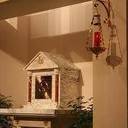
In every Catholic Church, there is a 'box' called the tabernacle where consecrated Hosts (Our Lord Himself) are reserved for adoration, worship, and for distribution of Holy Communion during the Mass and for the sick. One way to recognize the tabernacle is that usually a red or white candle will be burning very close to it to tell us that our Lord is present in the tabernacle. If the Blessed Sacrament is for some reason removed from the tabernacle, the light will be put out.
Read More
-

In 1950, in the Apostolic Constitution Munificentissimus Deus, Pope Pius XII proclaimed the Assumption of Mary a dogma of the Catholic Church in these words: "The Immaculate Mother of God, the ever-virgin Mary, having completed the course of her earthly life, was assumed body and soul into heaven." That belief was ancient, dating back to the apostles themselves. What was clear from the beginning was that there were no relics of Mary to be venerated, and that an empty tomb stood on the edge of Jerusalem near the site of her death. That location also soon became a place of pilgrimage. (Today, the Benedictine Abbey of the Dormition of Mary stands on the spot.)
Read More
-
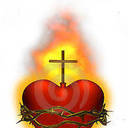
The Church celebrates the Solemnity of the Sacred Heart of Jesus on the Friday following the second Sunday after Pentecost. In addition to the liturgical celebration, many devotional exercises are connected with the Sacred Heart of Jesus. Of all devotions, devotion to the Sacred Heart was, and remains, one of the most widespread and popular in the Church.
Read More
-

The Vatican City/papal flag consists of two equal vertical stripes of yellow and white (with the insignia of the papacy on the white stripe), a triple tiara over two crossed keys, one of gold and one of silver, tied with a red cord and two tassels. The divisions of the tiara represent the teaching, sanctifying and governing offices of the pope. The keys symbolize his role as the successor of St. Peter and the universal spiritual authority of the Holy Father. The papal flag is also a national flag as it represents the sovereign state of Vatican City.
Read More
-

The crucifix is meant to be real and part of the artist’s experience. The crucifix had to show real suffering. Actually, the crucifixion of Jesus is also redemption through suffering and death. I wanted to show it. This crucifix also portrays Christ as primarily a black man, which I believe is important to show. Being Black in the world and especially in this country, our suffering is united with Christ’s suffering – but glorious suffering.
Read More
-

Many Catholic altars, have three steps leading from the floor to the level of the altar. This is used to symbolize the trinity of Father, Son and Holy Spirit. In walking up the steps at the beginning of Mass, the Priest, who acts in the place of Christ at each Mass, also symbolically acts out Christ’s literal rising from the earthly tomb after three days, completing the sacrifice and redemption that is re-presented at every Catholic Mass throughout the world.
Read More
-
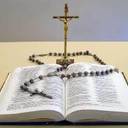
Did you ever wonder how the Bible came into being? A little known, but easily documented fact is that the books of the Bible were compiled by the Catholic Church. For many years after Christ ascended into Heaven, there was debate about which scriptural writings were inspired by God. The canon of Scripture (the books of the Bible) was first formally decided at the Synod of Rome in 382.
Read More
See More